
When aphids settle on beans or powdery mildew starts to whiten zucchinis, we look for a quick solution with what we have on hand. Kitchen garlic, stored in a corner of the pantry, has long served this purpose in gardens managed without synthetic products. Preparing homemade garlic infusion requires little equipment, but the method and dosage make all the difference between an effective preparation and a liquid that burns young leaves.
Garlic infusion, decoction, or maceration: the confusion that changes the outcome
We often talk about “garlic infusion” out of habit, but the term actually covers several distinct preparations. Confusing them risks inappropriate dosing or failed preservation.
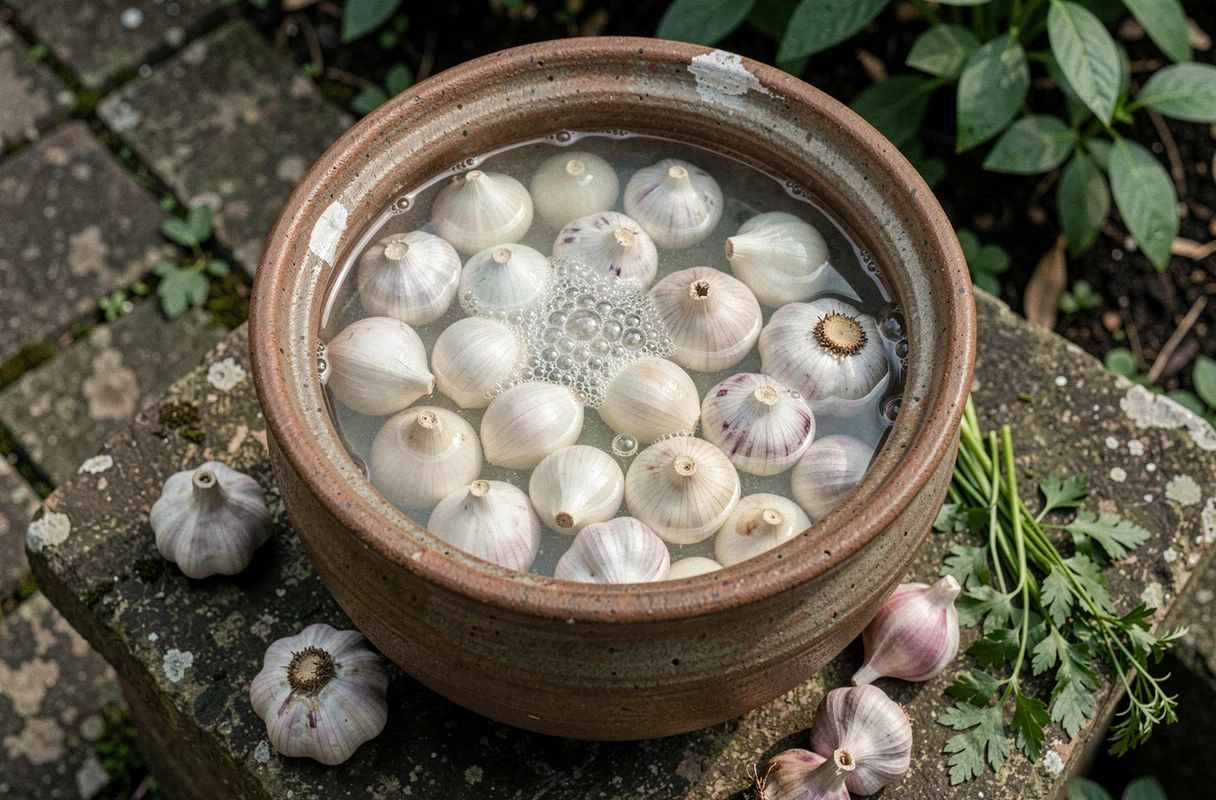
Garlic maceration involves soaking chopped cloves in cold water for a few days, without fermentation. The resulting liquid is light, usable quickly, but its duration of action remains short.
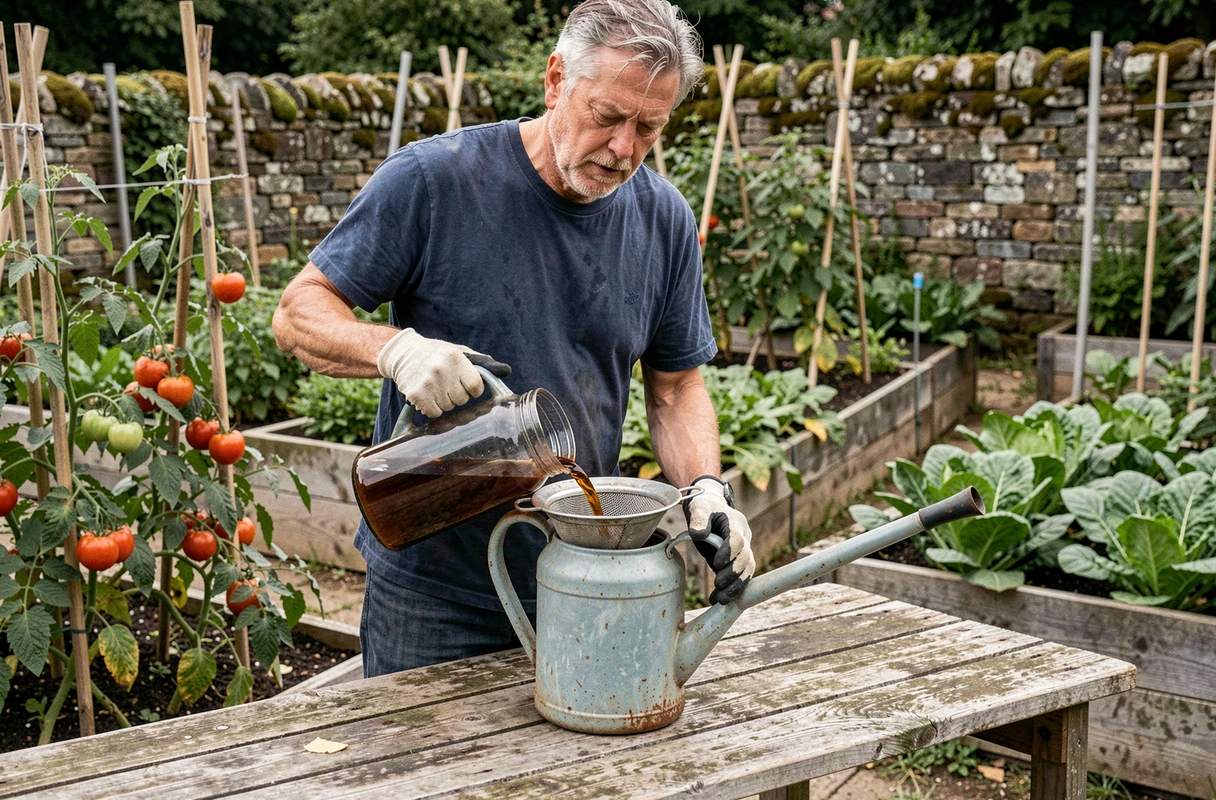
The decoction, on the other hand, involves a prior soaking of about a day followed by a gentle boil for about twenty minutes. Keeping the lid closed during cooking and cooling limits the loss of volatile sulfur compounds, which are precisely the active molecules. This detail of the process is rarely mentioned, yet it conditions the strength of the result.
The true infusion, in the strict sense, requires a long fermentation (several days to several weeks), recognizable by the appearance of bubbles and then a pronounced odor. For garlic, this method is less common than for nettle or comfrey, as fermentation degrades some of the active sulfur compounds. In practice, the decoction remains the most reliable method for garlic.
If you want to make garlic infusion for the garden with a proven protocol, the covered decoction yields the best results for vegetable crops.
Garlic decoction recipe: the steps that really matter
There are dozens of variants online. Here is the basic method that works, and especially the points where mistakes are most often made.
Ingredients and proportions
- One whole head of garlic (about ten cloves), peeled and coarsely chopped
- One liter of rainwater or settled water, to avoid chlorine that alters the active compounds
- One tablespoon of vegetable oil (rapeseed or sunflower) to improve adherence on the leaves
- One teaspoon of liquid Marseille soap, added after filtration, to facilitate dilution during spraying
Step-by-step preparation
Soak the chopped garlic in the liter of water for a full day, at room temperature and away from light. This soaking initiates the release of allicin, the sulfur compound that gives garlic its strong odor and repellent effect.
Then bring the mixture to a simmer (not a rolling boil) for about twenty minutes, with the lid closed from start to finish. Let it cool without opening. Filter through a fine cloth or a tight sieve to recover only the juice.
Then add the vegetable oil and the Marseille soap. Shake well before each use, as the oily phase separates naturally.
Dosing and spraying in the vegetable garden: mistakes to avoid
The resulting decoction is a concentrate. Applying it pure to the foliage is the best way to scorch young shoots, especially in hot weather.
Dilute at a ratio of one volume of decoction to ten volumes of water before filling the sprayer. For fruit trees or mature roses, some gardeners go to one for five, but feedback varies on this point depending on the variety and sunlight.
Evening application is preferable. It reduces the risk of leaf burn and allows the sulfur compounds time to act overnight, when evaporation is minimal. Spray on the underside of the leaves, where aphids, whiteflies, and mites reside.
A test on a few leaves the day before the full treatment remains a good habit. If brown spots appear, dilute further.
Pests and diseases targeted by garlic infusion
Garlic is not an insecticide in the strict sense. Its mode of action relies on a olfactory barrier that repels pests rather than direct toxicity. This nuance explains why the effect lasts only a few days to a week at most, and why it is necessary to renew the sprays regularly.
The pests sensitive to this olfactory repulsion are more numerous than one might think:
- Aphids on roses, beans, and cabbages
- Whiteflies in greenhouses and outdoors
- Caterpillars and bugs on tomatoes and brassicas
- Ants, whose presence encourages aphid colonies
- Slugs, to a lesser extent, by spraying on the ground around the plants
Regarding diseases, the sulfur contained in garlic acts preventively against major fungal diseases. It is used against downy mildew, powdery mildew, fruit tree moniliosis, and peach leaf curl. The action remains preventive: once the disease is established, garlic infusion alone is no longer sufficient.
Storage of garlic infusion: a short window
Garlic decoction keeps for one to three weeks in the refrigerator, in a closed and opaque container. Beyond that, the odor becomes rancid and the active compounds degrade. Preparing small quantities as needed yields better results than storing a large container.
For cold maceration (without cooking), the duration is even shorter: a few days at most. The absence of heat has not stabilized the molecules, and uncontrolled fermentation can make the mixture unpredictable.
Label your bottles with the preparation date. An expired garlic infusion poses no danger to plants, but it loses all repellent and fungicidal effectiveness, which amounts to spraying dirty water.
Garlic infusion does not replace crop rotation or a living soil. It fits into a logic of complementary natural treatments, alongside nettle infusion for fertilization or horsetail decoction to strengthen plant defenses. Preparing the right formulation, at the right dosage, at the right time of day: this is where the difference between a useful action and an ineffective watering is made.