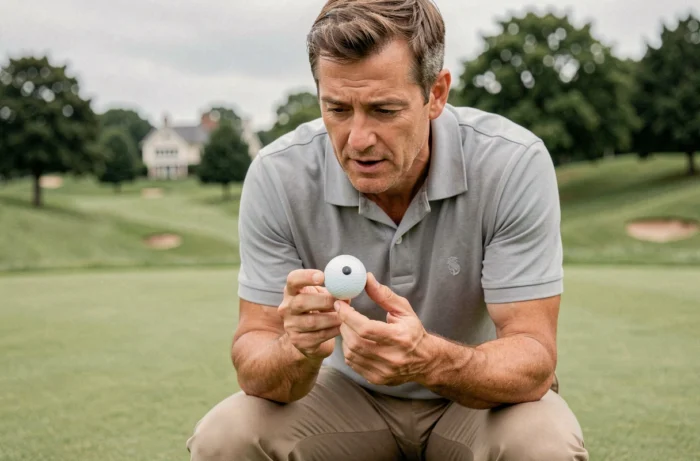
Locate a lost ball, measure the actual distance of a drive, analyze the roll of a putt: several technologies compete for these functions on the course. The golf ball with integrated GPS promises to combine these uses into a single object. To assess what this innovation concretely changes, it is necessary to compare the available systems and what they measure.
GPS, RFID or radar: which tracking technology on the golf course
The term “GPS ball” actually encompasses several distinct technical approaches. Confusing them skews the analysis of the real benefits for the player.
| Technology | Principle | Data provided | Main limitation |
|---|---|---|---|
| Active RFID (e.g. Chiping) | Chip integrated into the ball, communicating with the smartphone via the app | Ball position, distance to the green, course obstacles | Limited signal range, dependence on app mapping |
| Radar capture (e.g. Titleist RCT) | Radar-reflective marking integrated into the ball, read by a launch radar | Spin, launch speed, flight conditions | Designed for indoor use, requires a compatible radar (TrackMan 4, Garmin Approach R10, FlightScope) |
| Putting sensor (e.g. CHIP’d Golf) | Electronics embedded in a training ball | Launch, roll, speed, and result of the putt in real-time | Limited to putting, not for long game |
| External GPS (watch, rangefinder, app) | Device worn by the player, not integrated into the ball | Distance to obstacles, course mapping | Does not locate the ball itself |
The Chiping ball, presented as the world’s first golf ball equipped with a GPS geolocation system, uses an active RFID chip and connects to an app referencing over 35,000 courses. It displays the player’s position and that of the ball on the smartphone screen.
A golf ball with integrated GPS does not serve the same function as a Titleist RCT ball. The former locates, the latter measures the swing. Both carry the label “connected ball,” but their contributions diverge completely.
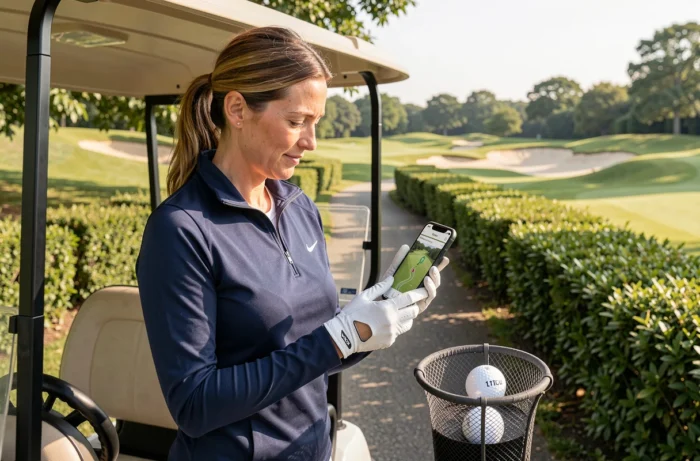
Location data versus swing data: what each connected ball really measures
The fundamental distinction lies in the nature of the data collected. An RFID chip ball answers the question “where is my ball?”. A radar ball answers “how did I hit it?”.
Course location and management
The Chiping ball reduces search time by indicating the position on the course mapping. The manufacturer claims that this reduction in time spent searching allows for faster play and limits penalties related to lost balls. For a casual player, finding each ball removes stress and penalty strokes.
The associated app displays the distance to the green and signals obstacles. This information is similar to what a traditional golf GPS (watch or rangefinder) provides, with the advantage that the position of the ball itself appears on the map.
Gesture analysis and indoor training
The Titleist RCT balls, equipped with radar-reflective technology, enhance the capture of spin and speed data in an indoor environment. They are validated with several launch radars: TrackMan 4, Garmin Approach R10, Full Swing KIT, FlightScope X3, and FlightScope Mevo+. Spin data becomes usable indoors thanks to radar marking.
However, these balls do not provide any location information on the course. They do not contain a GPS chip or a communication system with a smartphone.
The niche of connected putting
CHIP’d Golf offers a training ball with embedded electronics that measures launch, roll, speed, and the result of the putt in real-time. Instant feedback on each putt transforms training on the green into an analysis session, where a player previously relied solely on their feel.
Accessibility and lesser-known use cases of the geolocatable ball
Content on connected balls focuses almost exclusively on sports performance. One concrete use case remains under-documented: assistance for visually impaired or blind golfers.
Specialized guides indicate that sound or geolocatable balls enable players with visual impairments to locate and track their shots with greater confidence. Geolocation opens golf to players who were partially excluded.
This benefit goes beyond the logic of score optimization. It relies on the same RFID or GPS technology, but with an impact that pertains to sports accessibility.
Integrated GPS ball or external system: selection criteria for golfers
The market tends to structure around external tracking systems (GPS watches, laser rangefinders, portable radars) rather than a “pure” GPS ball. Several criteria help determine which system corresponds to which profile.
- The player who regularly loses balls benefits the most from a ball with an active RFID chip, as it directly solves the location problem on the course.
- The player who works on their swing in an indoor simulator needs a radar-compatible ball (like Titleist RCT) to obtain reliable spin and launch data.
- The player who wants to improve their putting with objective data turns to a connected training ball (like CHIP’d Golf) with real-time feedback on the smartphone screen.
- The player who is only looking for distance to the green and course mapping can settle for a GPS watch or mobile app, without changing balls.
The choice is not about “connected ball or not,” but about what type of data is missing from your game. A geolocatable ball does not replace a launch radar, and vice versa.
RFID chip balls like the Chiping integrate multi-layer constructions (rubber core, Surlyn cover, active coating) that aim to maintain performance comparable to that of a classic premium ball. The embedded technology must not degrade playing characteristics for adoption to be viable.
The real variable to monitor remains software compatibility. Radars validated with RCT balls require up-to-date firmware for spin data to be accurate. Geolocation apps depend on the mapping available for the course played. Before investing, checking that your equipment and course are supported avoids disappointments.