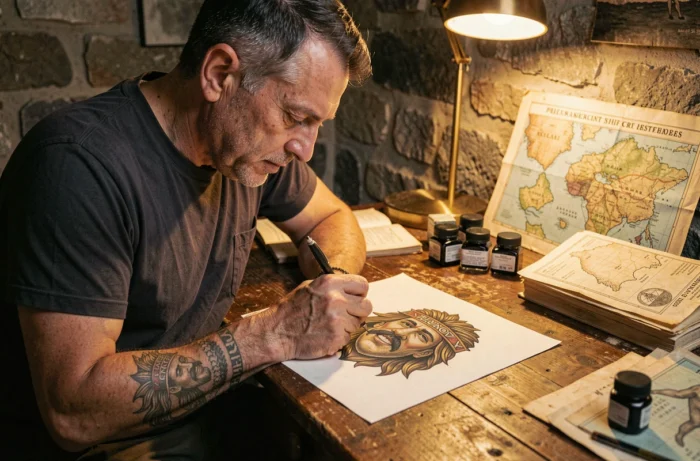
When you push open the door of a tattoo parlor in Corsica, the most common request revolves around a single motif: the head of Maure. But behind this profile face with a white bandana, there is a heraldic, political, and personal reading that most bearers do not suspect. Understanding Corsican symbols in tattooing is first about accepting that each line refers to a specific story, not just a simple tourist logo.
Bandana up or bandana over the eyes: a common mistake in the parlor
The first concrete question that arises before tattooing a head of Maure is the position of the bandana. On the official flag of the Collectivity of Corsica, the bandana is raised on the forehead, revealing the gaze. This version dates back to the modification attributed to Pascal Paoli, a central figure in Corsican independence.
Feedback on this point varies among tattoo artists: some clients arrive with a visual where the bandana covers the eyes, inspired by old representations related to the Kingdom of Aragon. Others strictly want the Paoli version, with the bandana raised, because it symbolizes regained freedom.
In practice, choosing one version or the other completely changes the meaning of the tattoo. A bandana over the eyes refers to an older historical reading, sometimes associated with domination. A raised bandana asserts an identity of resistance. Before approving a stencil, it saves time to clarify this detail with your tattoo artist, as altering a few millimeters of a line on the forehead of a tattooed face is not trivial.
To better understand Corsican symbols in tattooing and their iconographic nuances, one must go back to this heraldic distinction before choosing a graphic style.
Head of Maure in tattooing: official symbol or decorative motif
The head of Maure is not just a cultural motif. It is the official emblem of the Collectivity of Corsica, present on administrative documents, public buildings, and the flag. This institutional dimension changes the game when worn on the skin.
For a Corsican, getting this symbol tattooed is often a strong act of identity, akin to a family crest. For a tourist, the approach is different: it is a souvenir from the island, a Mediterranean aesthetic. Tattoo artists on the island report that visitor requests tend to focus on stylized versions, sometimes mixed with the silhouette of the island or plant elements.
This coexistence between identity use and decorative use sometimes creates misunderstandings. A motif perceived as a tribute by the bearer can be read as appropriation by someone else. We are not talking about written rules here, but about a collective feeling that is better to understand before committing to ink.
Nationalist iconography, a sensitive terrain
Some motifs go further than the head of Maure. The Ribellu, a hooded figure associated with the Corsican nationalist movement, regularly appears in requests. This symbol carries an explicit political charge that goes beyond simple decorative tattooing.
For a tattoo artist, offering this motif without explaining its significance would be a professional mistake. The Ribellu refers to decades of armed struggle and territorial claims. Tattooing it on an arm without context is like carrying a flag whose history you do not know.
Minimalist Corsican tattoo: the trend towards olive branches
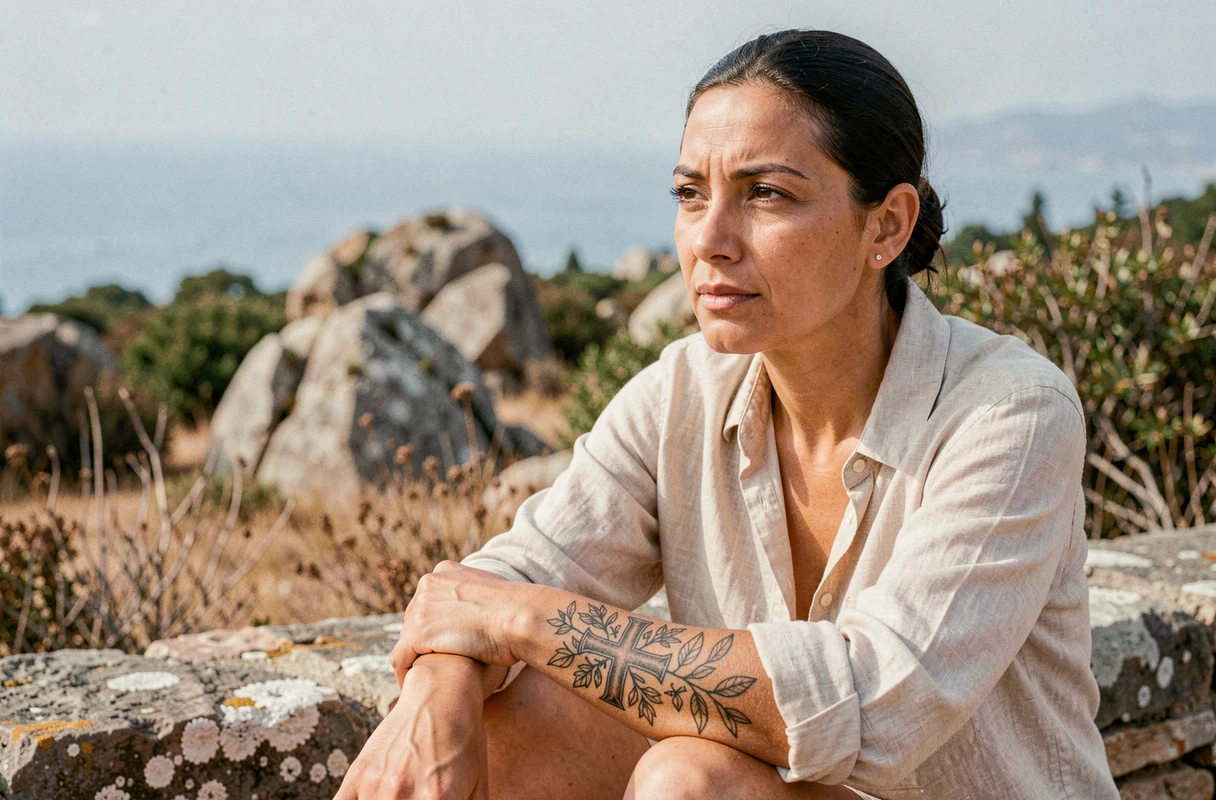
In recent years, there has been a shift towards more discreet Corsican tattoos. Instead of a realistic head of Maure, some tattoo artists create the silhouette of the island entirely in olive branches, creating a poetic and refined motif.
This minimalist approach responds to several practical constraints:
- A reduced format that fits on a wrist, ankle, or behind the ear, where a detailed face would be illegible
- A fine line rendering that ages better on small surfaces, without blurring over the years
- A more intimate reading of the symbol, which avoids direct questions about political affiliation
The olive tree itself carries a strong meaning in Corsica. A centuries-old tree omnipresent in the maquis, it evokes resilience and rootedness. Associated with the map of the island, it produces a tattoo that speaks as much of geography as of temperament.
Choosing your Corsican motif: criteria to check before the appointment
Before booking a session, a few points deserve to be settled in advance. The choice of the Corsican symbol is not limited to an aesthetic question.
- Position of the bandana: raised (Paoli, freedom) or over the eyes (Aragon, old historical version). This detail alters the meaning of the tattoo
- Personal context: family connection to the island, travel memory, or simple graphic appeal. A Corsican tattoo artist will likely ask this question
- Body area and size: a detailed head of Maure requires sufficient surface area (shoulder, calf, back). Minimalist versions adapt better to small areas
- Graphic style: realistic, geometric, dotwork, fine line. Each technique influences the readability of the symbol over the long term
Meaning of complementary motifs
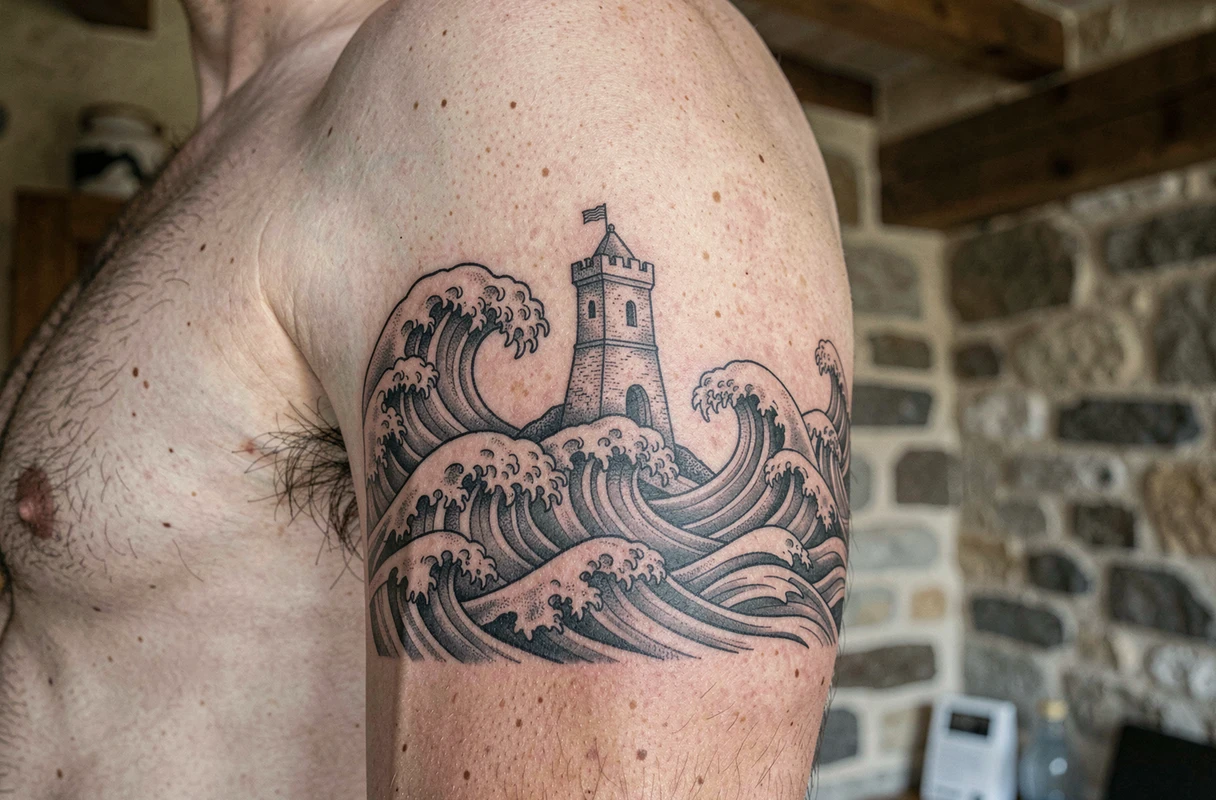
Many Corsican tattoos combine several elements. The map of the island associated with the head of Maure forms the most classic duo. One can also find the maquis (strawberry tree, rockrose, heather), the sea stylized in waves, or references to the Genoese towers that punctuate the coastline.
Each addition modifies the overall reading. A Corsican tattoo rarely tells just one thing: it layers a place, an affiliation, and a personal aesthetic. It is this accumulation of layers that distinguishes a thoughtful motif from a simple copy-paste found online.
The Corsican symbol tattooed remains a living object, carried by people who do not all interpret it the same way. Whether the bandana is raised or not, whether the olive tree replaces the face or accompanies it, the motif only takes its full meaning with the story of the bearer.