
During a casting for a health insurance campaign, a 65-year-old model discovers that her remuneration is broken down into two distinct lines: the fee for the photo shoot, and then a royalty for each medium where her face appears. This dual logic, specific to modeling, radically changes the final amount received. However, it remains poorly understood by the majority of senior candidates entering the profession.
Performance Fee and Image Royalty: Two Lines Not to Confuse
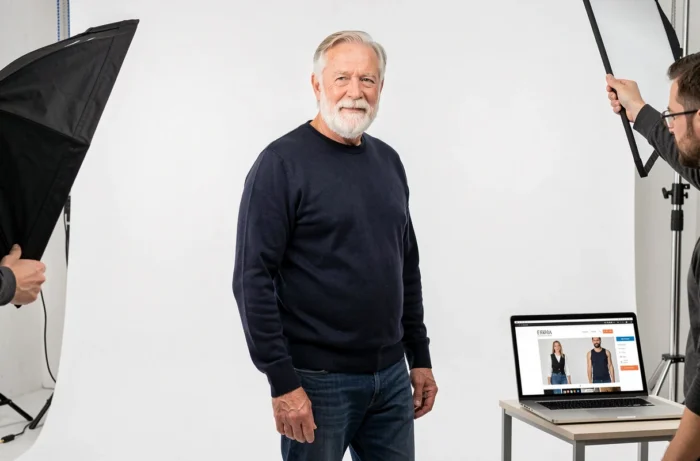
The remuneration of a senior model is based on two distinct mechanisms. The first is the salary paid for the performance itself: studio photo shoot, video shoot, runway show. The second corresponds to the royalty related to the use of the image across different media (advertising, web, press, social networks).
In practical terms, one can be paid for a day of shooting, and then receive an additional payment if the campaign is broadcast on a 4×3 billboard in addition to the initially planned website. The royalty depends on the scope of use negotiated in the contract: duration, geographical territory, number of media.
This is where the remuneration of senior models varies the most from one assignment to another. A face used for six months in a national campaign earns much more than a photo limited to a local catalog distributed for three weeks.
Agencies with a state license formalize all this in an employment contract. The model then becomes an employee of the agency, which invoices the client and pays the fee after deducting its commission.
Senior Models on the Web: What the 2023 Influence Law Changes
When a senior model appears on social media or in sponsored online content, the rules go beyond the simple classic modeling contract. Since the law of June 9, 2023, and its implementing order of November 6, 2024, any commercial collaboration must be disclosed in a visible and understandable manner.
A brand tag or the mere presence of a product on screen is not enough. The DGCCRF requires that the commercial intent be explicitly mentioned, with phrases like “advertisement” or “commercial collaboration.” The 2024 order has relaxed the form (an equivalent mention adapted to short formats is accepted), but not the substance.
For senior models monetizing their image on Instagram or in videos, this means:
- Ensuring that each sponsored post includes a readable advertising mention at first glance, including in short formats like stories or reels.
- Considering that the notion of compensation is not limited to a payment in euros: a gifted product, a trip, equipment, or an affiliate commission are also forms of remuneration under the law.
- Formalizing the collaboration in writing, even for modest amounts, as the legal risk has been heightened with administrative and criminal penalties for non-compliance.
Many senior profiles are still seen posting content for dietary supplement or wellness brands without any mention. The lack of advertising transparency exposes one to fines, regardless of the creator’s age.
Senior Model Contract: Clauses That Affect Final Remuneration
Beyond the gross amount, several contractual clauses determine what one actually receives. The first is the duration of use. A contract that allows the use of the image for one year earns more than a contract limited to three months, but it also blocks the possibility of working for a direct competitor during the same period.
The exclusivity clause is the most underestimated negotiation lever. If a glasses brand requires that the model does not appear for any optical competitor during the contract period, this restriction must be reflected in an increase in the fee. In practice, responses vary on this point: some beginner senior models accept exclusivity without financial compensation due to a lack of experience in negotiation.
The distribution territory also matters. A campaign reserved for metropolitan France and a global campaign are not billed the same way. When signing through an agency, it is the agency that negotiates these parameters. Directly, one must read every line of the contract before committing.
Agency Commission and Employee Status
Model agencies take a commission from the gross fee. The model, as an employee of the agency, receives a payslip with social contributions. This status provides protection, but it mechanically reduces the net amount received compared to the gross amount announced.
For web assignments (shooting for e-commerce, sponsored content), some structures offer short contracts like fixed-term contracts for use. The employee status remains the legal norm for any modeling service in France, even if occasional.

Senior Advertising in France: Why Brands Pay for Authenticity
Brands targeting an audience over 55 years old find that visuals featuring senior models generate more trust. A health, insurance, or cosmetic campaign aimed at this age group converts better when the face matches the actual customer.
This growing demand has a direct effect on fees. Senior profiles with a natural appearance, far from the standards of classic modeling, are sought precisely because they embody authenticity. Specialized agencies like Master Models, Silver, or Kalao have structured their offerings around this positioning.
Senior modeling does not require standardized measurements, which broadens the pool of candidates. Brands are looking for expressive faces, a natural posture in front of the camera, and the ability to convey emotion in just a few seconds of shooting.
The portfolio remains the key to landing castings. A few portrait and full-body photos taken by a professional photographer are enough to approach agencies. The digital format has become the standard, with paper portfolios nearly disappearing from selection circuits.
Remuneration in this sector thus depends as much on the type of campaign as on the contractual framework. A senior model well-informed about the distinction between fee/royalty, about obligations related to the web, and about exclusivity clauses is positioned to negotiate a realistic supplementary income, without unpleasant surprises when reading the payslip.