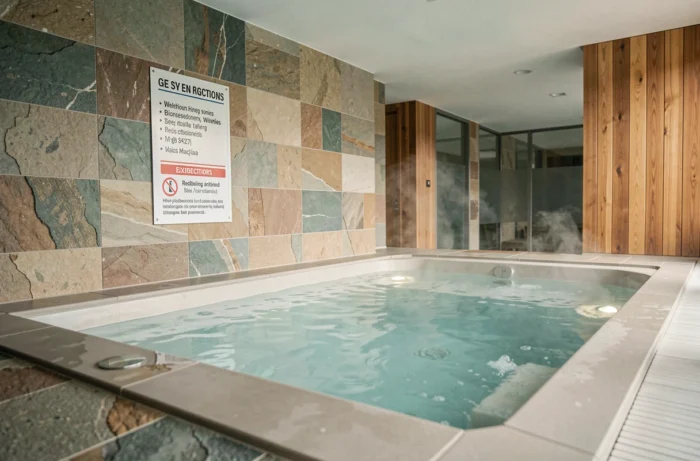
A child who sees bubbles and warm water wants to dive in. The reflex is natural. But in France, access to jacuzzis in public establishments is prohibited for those under 16 years old, and this rule is based on specific physiological reasons. Understanding why this prohibition exists also helps to better protect children at home, where no regulations apply with the same rigor.
Thermoregulation in children: why the warm water of a jacuzzi poses a problem
A child’s body does not manage heat like an adult’s. Its body surface is proportionally larger compared to its weight, which accelerates thermal exchanges. When immersed in water that is significantly warmer than their body temperature, a child experiences an internal temperature rise faster than an adult.
This phenomenon has a name: hyperthermia is the main danger of jacuzzis for children. Unlike heat stroke in direct sunlight, hyperthermia in warm water develops insidiously. The child does not sweat in the water, which eliminates the natural cooling mechanism. Warning signs (nausea, drowsiness, confusion) may appear too late.
The Centers for Disease Control and Prevention (CDC) recommend not allowing children under 5 years old to use a jacuzzi, precisely because of this combined risk of hyperthermia and silent drowning in warm, shallow water. A detailed article on Idees-maison.com discusses all these issues for families.
Infectious risks in a spa: legionella and unknown pathogens
The temperature of a jacuzzi, typically maintained between 35 and 40 °C, creates a favorable environment for the proliferation of microorganisms. Competitors often discuss skin irritations or fungal infections. However, two pathogens deserve particular attention.
Legionella in hot water circuits
Legionella proliferates in lukewarm water between 25 and 45 °C. In jacuzzi circuits, the aerosolization produced by bubble jets disperses these bacteria into the surrounding air. A child, whose immune system is still maturing, is more vulnerable to this. This is one of the reasons why regional health agencies (ARS) impose strict disinfection protocols on hotels and wellness centers.
Naegleria fowleri: a rare but documented risk
This amoeba, sometimes referred to as the “brain-eating amoeba,” thrives in poorly disinfected warm waters. When water enters the nasal passages, it can cause meningoencephalitis, an infection that is almost always fatal. The risk remains extremely rare in a well-maintained spa, but it explains why the quality of disinfection is a non-negotiable condition for any pool open to the public.
These infectious risks also concern adults, but the immunological fragility of children justifies a strengthened precautionary principle in public establishments.
Jacuzzi prohibition for under 16s: what French regulations say
You may wonder why the limit is set at 16 years and not at 12 or 14? French regulations clearly distinguish between two contexts.
- In public establishments (campgrounds, hotels, aquatic centers), access to jacuzzis is prohibited for minors under 16 years old. This rule aims to protect children in an environment where individual supervision cannot be guaranteed by the operator.
- At home, no law formally prohibits a child from using a private spa. The responsibility lies entirely with the parents, who must adjust the temperature, duration, and supervision.
- Operators of public establishments bear civil and criminal liability in the event of an accident. The prohibition allows them to limit this legal risk while applying an age threshold consistent with health data.
The threshold of 16 years corresponds to the point at which an adolescent’s thermoregulation system approaches that of an adult. Before this age, safety margins are not sufficient in a collective setting.
Private spa and children: adapt conditions rather than prohibit
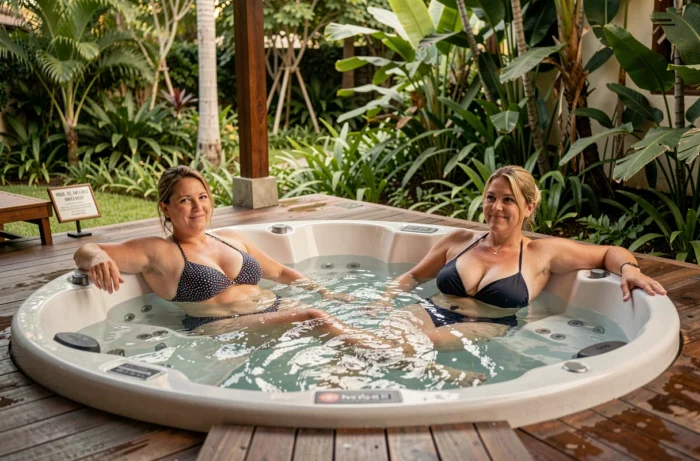
At home, the approach is different. A parent can allow access to the spa as long as they modify the bathing parameters. Why this choice? Because the risk is not the jacuzzi itself, but the conditions under which it is used.
The first measure concerns temperature. For a child, the water temperature should not exceed 30 to 32 °C, which is well below the usual setting for adults. At this level, the risk of hyperthermia decreases significantly.
The duration of bathing is the second lever. Sessions should remain short, around ten minutes. A child does not always feel thermal fatigue, hence the need to set a strict time limit.
- Check the temperature before each bathing session with a reliable thermometer, not just with the spa’s display
- Deactivate or reduce the power of the jets to avoid any physical imbalance for a young child
- Never leave a child alone in the pool, even for a few seconds
- Cover the spa with a rigid, lockable cover when not in use
These precautions transform a potentially dangerous piece of equipment into a controlled family moment. The difference between a public spa and a private spa lies in this adaptability that the home environment allows.
Prevention and maintenance of the spa: protecting children’s health daily
A poorly maintained jacuzzi poses a risk for everyone, but more so for a child whose skin is more permeable and whose respiratory system is more sensitive to contaminated aerosols.
The water treatment must be checked at least twice a week in a regularly used home spa. pH, disinfectant levels, and water clarity are three indicators to monitor. A chemical imbalance can cause skin irritations in children well before an adult feels anything.
The spa filter requires regular cleaning. A clogged filter allows particles and microorganisms to circulate that the disinfectant alone does not always neutralize. Showering before entering the pool remains a simple yet effective measure to limit the introduction of external contaminants.
The prohibition of jacuzzis for those under 16 in public places is not an excessive precaution. It reflects documented physiological and infectious realities. At home, adapting temperature, duration, and maintenance allows for family spa sharing without replicating the risky conditions that justify the prohibition in collective establishments.