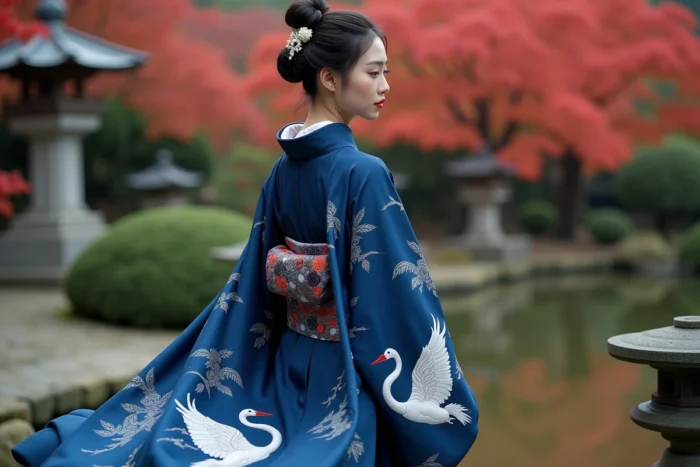
When you put on a kimono for the first time, it’s the sleeves that pose a problem. They drag in the soy sauce dish, get caught in a sliding door, and hinder reaching for an object on a shelf. The long sleeves of the Japanese kimono are not just a decorative detail: they encode the social status, age, and degree of formality of the person wearing it.
Furisode and Short Sleeves: What the Cut Says Before Words
On the ground, the first thing a professional dresser checks is the length of the sleeves. A furisode (literally “swinging sleeves”) can sometimes reach down to the ankles. This type of kimono is reserved for unmarried women during formal occasions. Wearing a furisode at a casual event or after marriage is considered a faux pas.
In contrast, contemporary men’s kimonos have significantly shorter and less voluminous sleeves. This difference is not trivial: it immediately signals the gender and style of the outfit. As explained by the kimono sleeves on Mademoiselle Camille, there is a true coded language of clothing defined by the length of the fabric.
Opinions vary on this point, but most guides aimed at foreign visitors to Japan emphasize: choosing the wrong sleeve cut for a given event remains the most common mistake. More than the pattern or color, the length of the sleeves determines the level of formality of traditional Japanese clothing.
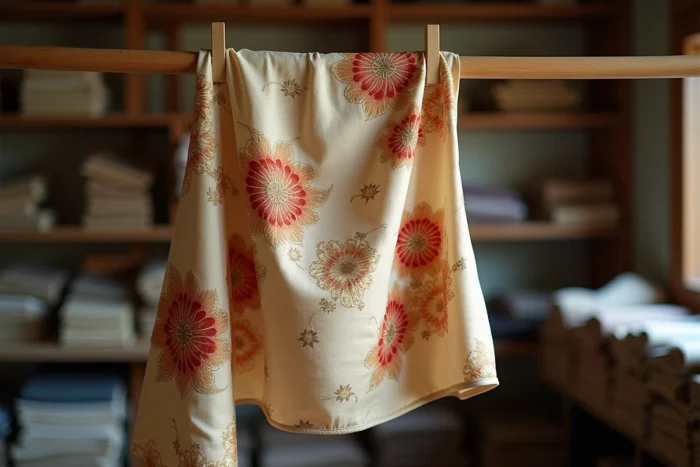
Women’s Kimono Sleeves: Markers of Age and Marital Status
In current Japanese practice, three main categories of sleeves structure the women’s wardrobe:
- The furisode (long, flowing sleeves, sometimes close to the floor): worn by young unmarried women, especially during the coming-of-age ceremony or at weddings where they are invited
- The komon or tsumugi (medium-length sleeves): suitable for everyday outings, meals, or cultural visits, with no strict age-related code
- The tomesode (short sleeves, patterns only below the waist): reserved for married women for formal events like family weddings
This system is not based on a vague convention. A dresser preparing a client for a wedding ceremony systematically checks whether she is married or not before selecting the kimono. The fabric of the sleeves encodes precise social information, readable by all participants.
Why Long Sleeves Have Survived Modernization
Japan has gone through several waves of clothing modernization, particularly starting from the Meiji era (1868-1912). Western clothing gradually replaced the kimono in daily life. Long sleeves could have disappeared with this transition.
They have survived because they fulfill a function that Western clothing does not cover: visually signaling, without a word, a person’s social context during a ceremonial event. Formal Japanese occasions (weddings, funerals, tea ceremonies, festivals) still require a dress code where the cut of the sleeves plays a central role.
Sleeve Length and Practical Constraints in Daily Life
One might think that the long sleeves of the kimono are purely symbolic. In reality, they impose a specific gesture that wearers learn very early on.
When wearing a furisode, one holds the sleeve with the other hand to pour tea, open a door, or bow. This gesture, called “sode wo osaeru,” is part of the etiquette. It creates a characteristic silhouette, with slowed and controlled movements, found in Noh and Kabuki theater.
Long sleeves discipline the body as much as they decorate it. They require an upright posture, measured gestures, and constant attention to the space around oneself. This physical constraint is intentional: it contributes to the overall aesthetic of traditional Japanese clothing.
The Role of the Inner Sleeve Pocket
The sleeves of the kimono are not open on both sides. The lower part forms a kind of sewn pocket (tamoto) where small objects can be slipped in: handkerchief, fan, sometimes a wallet. Before the advent of handbags, the sleeves served as functional storage.
This inner pocket partly explains why the sleeves have retained their fullness. A garment without pockets in a context where nothing else is carried necessitates planning for storage space. The long, flowing shape of the fabric naturally creates this useful volume.
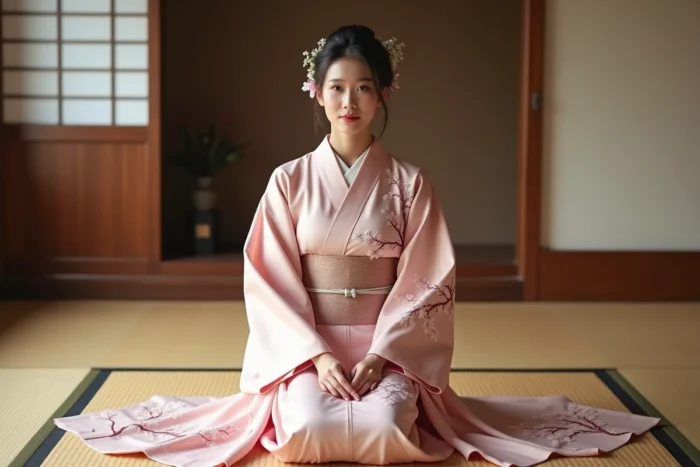
Contemporary Kimono: Sleeves as a Style Element
Contemporary Japanese and international fashion has adopted the cut of kimono sleeves. They can be found in blouses, dresses, and jackets sold under the name “kimono sleeves” or “Japanese sleeves,” although the cut is often simplified.
What distinguishes a true traditional kimono from an inspired piece is precisely the treatment of the sleeves:
- An authentic kimono has sleeves cut separately, with a specific seam at the shoulder and a calibrated opening under the arm (miyatsukuchi for women, closed for men)
- Kimono-inspired sleeves in Western ready-to-wear are generally cut from a single piece with the body of the garment, without an inner pocket or closure system
- The choice of fabric (silk, cotton, polyester) alters the drape of the sleeves and thus the overall look, a parameter that Japanese artisans adjust according to the intended occasion
The T-shape of the kimono, with its rectangular sleeves and lack of curved seams, remains one of the few cutting systems where every centimeter of fabric is used without waste. Long sleeves contribute to this logic of textile economy, inherited from a time when silk represented a considerable investment.
The sleeves of the Japanese kimono are neither a gratuitous ornament nor an anachronism. They condense social information, impose a gesture, serve as storage, and participate in a logic of textile sustainability. Their persistence in the Japanese ceremonial wardrobe is due to this functional as well as symbolic versatility.