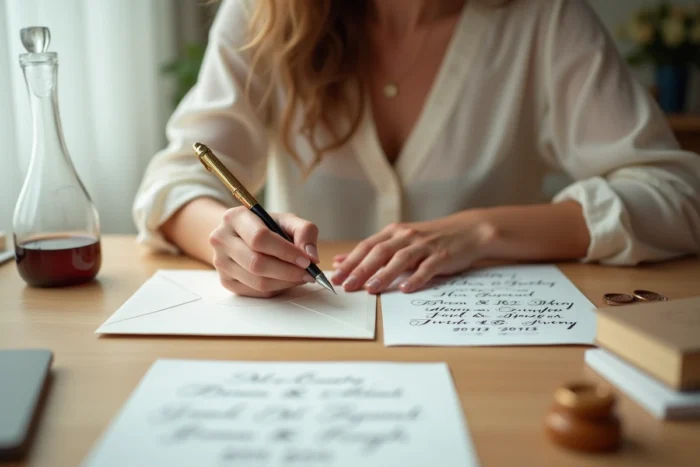
The address on a wedding envelope does not follow the same conventions as administrative mail. Between the appropriate forms of civility for each family situation, the placement of lines, and postal readability constraints, several parameters intersect. This article analyzes the discrepancies between standard postal rules and the specific practices of invitations, to identify what truly makes a difference in delivery and reception.
Standard postal rules and wedding practices: what diverges
The postal addressing standards (line structure, postal code, uppercase for the city) apply to all mail. The Post Office recommends a readable address, without any corrections, with the recipient’s name on the first line and the postal code followed by the city on the last line.
For a wedding envelope, these rules remain the technical foundation. Knowing how to write an address on an envelope in the context of an invitation also requires mastering the forms of civility, managing unmarried couples, families with children, and choosing between handwritten and printed text.
| Criterion | Standard mail (The Post Office) | Wedding envelope |
|---|---|---|
| Recipient line | Name + first name or business name | Complete civility (Mr. and Mrs., Family, first names only depending on the tone) |
| Civility formula | Optional | Expected, adapted to the relationship with the guest |
| Writing | Printed or handwritten | Handwritten strongly preferred (tradition) |
| Inner envelope | Nonexistent | Possible for formal sendings (names without address) |
| Children mentioned | Not applicable | Yes, if invited (first name on inner envelope or mention “and family”) |
| International guests | Country in uppercase on the last line | Same, with attention to the address format of the country |
The main divergence lies in the recipient line. A standard letter only requires a name. A wedding envelope encodes social information: who is invited, under what title, with or without children, with or without a plus-one.
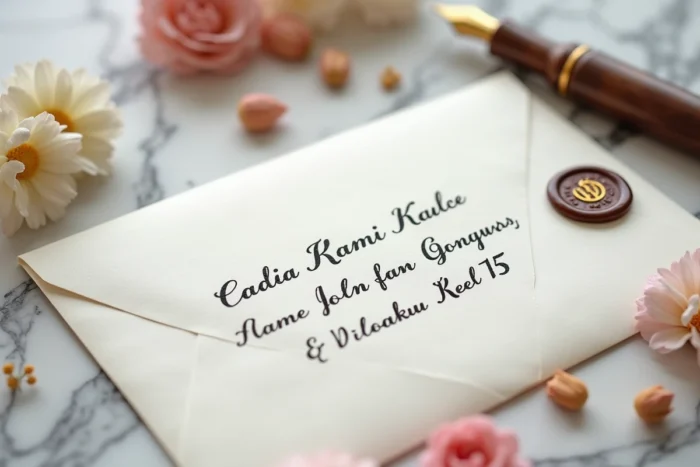
Civility formulas on the wedding envelope: each case
The formulation of the recipient’s name varies according to family situation and the desired level of formality. This is the point that generates the most hesitation.
Married or civil partnership couple
The formal convention remains “Mr. and Mrs.” followed by the shared last name. In a more casual register, both first names followed by the last name are sufficient. If the spouses have different last names, each name appears: “Mrs. Dupont and Mr. Martin,” or simply “Sophie Dupont and Pierre Martin.”
Unmarried couple
Each person keeps their full name on the envelope, connected by “and.” The formula “Mr. and Mrs.” does not apply here, as it implies a shared name. In an informal context, first names and last names side by side work without civility.
Family with children
To invite the whole family, the mention “Family” followed by the last name covers the entire household. If only the parents are invited, not mentioning the children on the envelope is sufficient to signal the limit of the invitation. For adult children living at home, a separate envelope is the formal norm.
Single person with or without a plus-one
The first name and last name of the recipient appear alone. If you wish to allow a plus-one, the mention “and partner” or “and guest” can be added.
- “Mr. and Mrs. Dupont” for a married couple sharing the same name, in formal register
- “Sophie Dupont and Pierre Martin” for an unmarried couple or a casual tone
- “Family Dupont” when parents and minor children are all invited
- “Claire Dupont and guest” for a single person offered a plus-one
Handwritten readability and postal delivery constraints
Wedding invitations are often handwritten, by tradition and to show attention to each guest. This practice creates a constraint that printed mail does not encounter: handwritten readability directly conditions proper delivery.
The optical sorting systems of The Post Office read printed addresses reliably. In the face of handwritten text, the automatic reading rate decreases. A poorly readable handwritten address can lead to manual sorting, delays, or even a return to the sender.
Some precautions reduce this risk:
- Use a black or dark blue ink pen, with a consistent stroke (light, gold, or metallic inks are poorly scanned)
- Write the postal code and city in uppercase, even if the rest of the address is in cursive
- Maintain clear spacing between lines, aligning left or center
- Avoid any decoration (swirls, stickers) in the addressing area, which covers the lower right third of the envelope
The postal code and city in uppercase remain the most strategic line for automated sorting. An error on this line has more consequences than a mistake on the first name.

International addresses on a wedding envelope
Online competitors rarely address the case of guests residing abroad. The address format varies from country to country: position of the postal code, city-region order, presence or absence of a state or province.
The destination country must appear on the last line, in uppercase, in the language of the shipping country (thus in French if you are posting from France). This rule facilitates international routing from the first sorting center.
For the rest of the address, it is recommended to respect the local format of the destination country. In the UK, the postal code comes after the city. In Germany, it precedes the city. In the United States, the final line includes the city, abbreviated state, and ZIP code. Consulting the postal operator of the relevant country avoids approximations.
Formal or casual tone: a choice that structures the entire envelope
The level of formality is not limited to the civility formula. It also determines the choice between calligraphic or simple writing, the use or non-use of an inner envelope, and the presence of complete titles (“Doctor,” “Master”) or just first names.
In a formal context, the outer envelope carries the complete address and the inner envelope the names without address. The inner envelope specifies exactly who is invited, including children by name. In an informal context, a single envelope with first names and last names is sufficient.
The choice must remain consistent with the tone of the invitation itself. A very classic card with a casually addressed envelope creates a noticeable mismatch. Conversely, a modern invitation does not support fixed formulas like “Mr. and Mrs. have the honor of.”
Consistency between the invitation and the envelope is as important as the correct spelling of the name. Checking each address, each name, each civility before writing remains the most effective precaution against social or postal missteps.