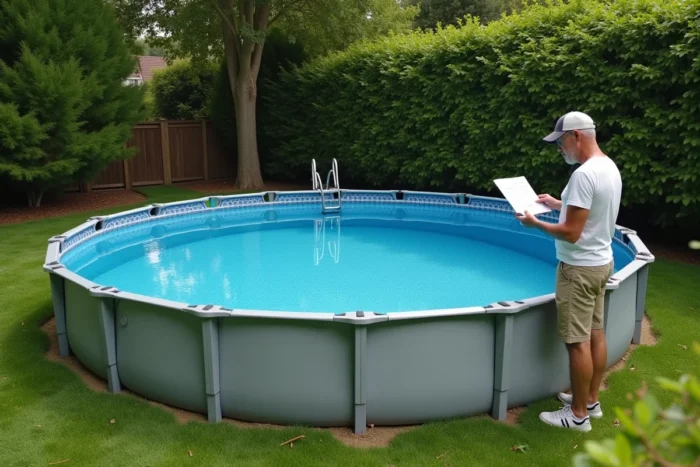
The Intex 58983 Metal Frame pool is a compact rectangular tubular pool (220 x 150 x 60 cm), designed for modest-sized gardens. Its structure rests on interlocking steel tubes that support a PVC liner, without an inflatable ring. Installing this type of above-ground pool takes little time, but the quality of the ground preparation directly affects the lifespan of the pool and the safety of its use.
Before unfolding the liner, it is essential to understand what is happening on the ground, beneath the pool, and to anticipate a point that most guides overlook: water management during drainage. This guide covers ground preparation, assembly, and regulatory constraints related to water disposal, so that the Intex 58983 metal frame pool remains functional all summer long.
Drainage and water disposal: a constraint to integrate from installation
Installation guides focus on filling and almost always forget about the end of the season. The issue of pool water disposal is regulated, and the answer directly influences the location you choose in your garden.
In sensitive areas (near watercourses, groundwater, catchment areas), direct disposal of water into the natural environment is prohibited, even for small private pools. The ARS Occitanie 2025 recommendations, used as a national reference, regulate the frequency of annual drainings.
In practical terms, this means that when choosing the location for your Intex Metal Frame pool, you must identify a compliant drainage point. A connection to the sewage network or a sufficiently large area to absorb water through natural infiltration are the two usual options.
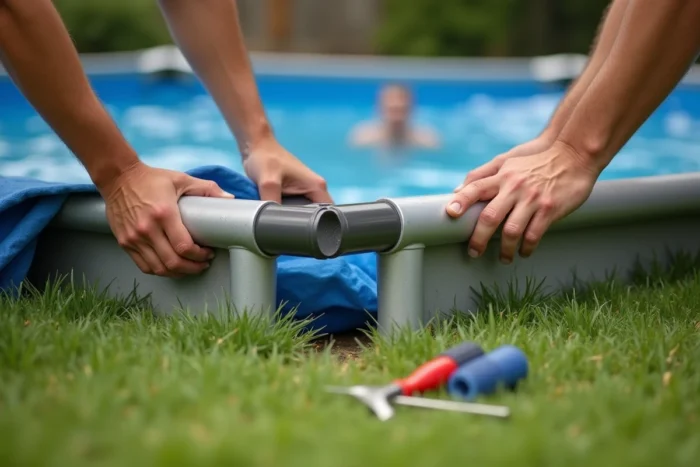
Planning for a slight slope directed towards the drainage point facilitates drainage at the end of the season. A few centimeters of elevation are sufficient. If your garden is perfectly flat, a garden hose connected to the drain plug will do the trick, provided you direct the water towards a permeable area of your land and not towards the street or a communal ditch.
Ground preparation for Intex tubular pool
The ground is the most underestimated factor when setting up an above-ground pool. Poorly prepared ground causes wrinkles in the liner, uneven water pressure distribution, and ultimately, premature wear of the structure.
Choosing and preparing the surface
The location must meet several technical conditions before unrolling anything:
- A hard, flat, and stable ground, free of stones, roots, or debris. Grass may be suitable as long as it is mowed short and cleared of any sharp objects that could puncture the liner.
- An area away from trees to limit leaf fall and roots that could create deformations under the pool over the weeks.
- Access to a water supply and an electrical outlet if you are using a filtration pump.
Before assembly, check the flatness with a level placed on a long board. A deviation of a few millimeters is tolerable. Beyond that, the water pressure will exert asymmetrically on the tubular structure, which can deform the metal legs.
Ground mat: a protection not to be neglected
Intex recommends using a ground mat placed between the ground and the liner. This mat protects the fabric from residual roughness (small gravel, dry blades) and limits moisture rise. It does not correct a flatness defect, but it absorbs the micro-irregularities that raking has not eliminated.
Step-by-step assembly of the Intex 58983 Metal Frame pool
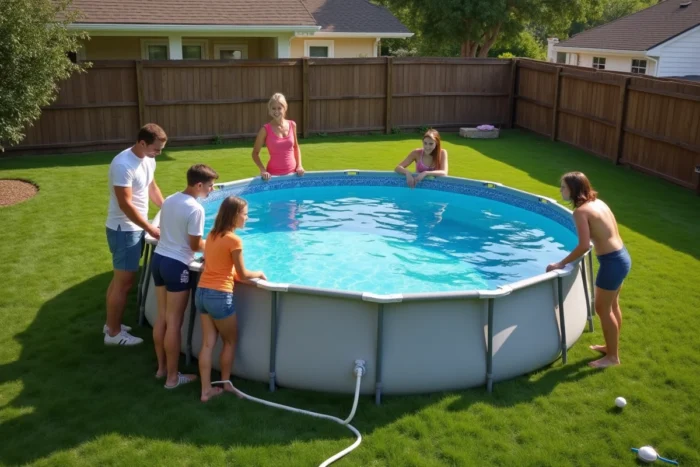
Assembling a Metal Frame tubular pool requires no tools. The entire structure fits together by interlocking. Two people are sufficient, and the operation usually takes less than an hour.
Unfold the liner and position the tubes
Spread the liner in the center of the ground mat, ensuring that the drain plug is oriented towards your planned drainage point. The steel tubes fit into the sewn loops along the upper edge of the liner. The vertical tubes (legs) connect to the horizontal tubes via T-connectors provided in the kit.
A common mistake is to fill the pool before checking the symmetry of the structure. Take the time to pull the liner towards each corner, smooth out the wrinkles on the ground, and ensure that all legs are resting flat.
Gradual filling
The filling should be gradual. Add a few centimeters of water, then readjust the wrinkles in the liner. A liner that is poorly positioned at the start cannot be corrected once the pool is filled. Water exerts uniform pressure that locks the wrinkles in place.
Fill to the mark indicated on the inner wall of the liner. Never exceed this level: overfilling puts stress on the metal connectors beyond their threshold of resistance and encourages overflow at the slightest movement in the pool.
Maintenance of the liner and filtration for Metal Frame pool
A pool of this size heats up quickly in the sun, which accelerates the development of algae and bacteria. Without regular maintenance, the water becomes cloudy in a few days.
The cartridge filtration system is the most common for this model. The pump sucks in water, passes it through a pleated paper filter, and then reinjects it into the pool. The replacement of the cartridge depends on the frequency of use and the outside temperature. Cloudy water despite filtration indicates a saturated cartridge that needs to be changed.
In addition to mechanical treatment, minimal chemical treatment (chlorine or active oxygen suitable for small volumes) maintains water quality between two filtration cycles. Be careful with dosages: a small pool reacts much faster than a large pool to variations in chemical concentration.
Covering the pool with a protective tarp when not in use reduces evaporation, limits debris fall, and slows down water heating. For a model of this size, it is one of the most effective actions to space out maintenance interventions.
Installing a Metal Frame tubular pool in a garden remains a simple operation as long as you do not rush the ground preparation phase and plan for water management beyond just filling. The choice of location, dictated as much by the flatness of the ground as by the proximity of a compliant drainage point, determines the comfort of use for the entire season.