
A traveler books a flight to Japan using her married name, the one she uses daily. At check-in, the ground staff compares the ticket to the passport, reads the birth name printed in the machine-readable zone, and blocks boarding. This scenario frequently appears on travel forums and is based on a confusion between the usage name and the legal name that French law inadvertently perpetuates.
Birth name and usage name on a French passport
In France, marriage does not change the family name. The name recorded in the civil registry remains the birth name, the only legal name recognized. The spouse’s name (or a double name) constitutes a usage name, mentioned on the passport for informational purposes.
On a French passport, the machine-readable zone (the two lines at the bottom of the photo page) contains only the birth name. This is the zone that automated systems of airlines and customs scan. The married name, when it appears on the document, is higher up, in the visual section, preceded by the mention “ép.”.
This explains why knowing which name to put on a plane ticket for a married woman raises so many questions: the identity document bears two names, but only one is valid in airport databases.

Plane ticket for married women: which name to use for the reservation
The safest rule can be summed up in one sentence: the ticket must exactly match the machine-readable zone of the passport. In practice, the birth name and the first name are written as they appear in this zone.
When the married name works anyway
On domestic flights in Europe, using an identity card as the only document, the married name often passes without difficulty. The French identity card may display the usage name more prominently than the passport, and the check remains manual in most cases.
Responses vary on this point depending on the airlines and airports. Some low-cost airlines only check the match between the boarding pass and the presented ID, without automated scanning. Others apply strict checks aligned with the passport, even for a Paris-Marseille flight.
Destinations where the birth name is non-negotiable
As soon as a passport comes into play (flights outside the Schengen area, international layovers), the birth name is mandatory. Three cases deserve particular attention:
- The United States requires that the name on the ESTA form matches exactly with the passport. A married name on the ticket creates a discrepancy with the ESTA, which can lead to boarding denial.
- Asian countries (Japan, South Korea, Thailand) use automated border control systems that compare the machine-readable zone of the passport with the name recorded by the airline.
- Flights with a layover in a third country add an extra check: the passenger may transit through an intermediate customs that applies its own verification rules.
Changing a name on a plane ticket after booking
When an error is made, the correction depends entirely on the airline’s policy. On regular airlines (Air France, Lufthansa, Qatar Airways), a minor name correction is often possible at no charge if reported quickly after booking. We are talking about a correction, not a passenger change.
On low-cost airlines, changing the name is generally subject to a fee, and the price varies depending on when the request is made. The longer you wait, the higher the cost.
European reform on name corrections
An ongoing European reform aims to ensure that minor name corrections (typos, inversion of name/first name) will no longer be charged by airlines. This measure, adopted by the European Parliament, will apply after a transition period. For female travelers facing a discrepancy between usage name and birth name, this change could simplify corrections.
Expired passport or recent name change: concrete pitfalls
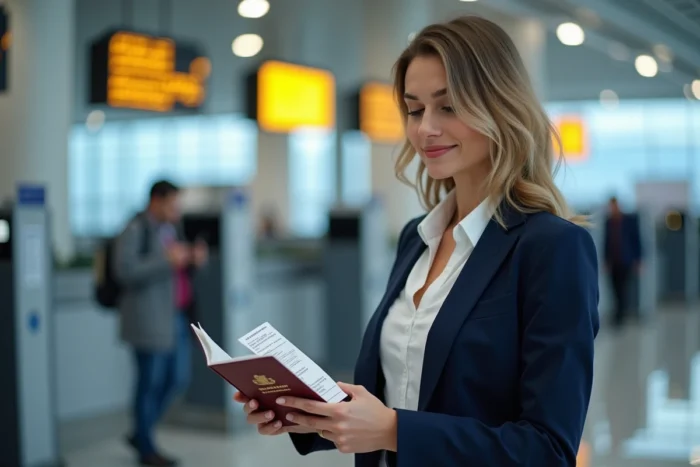
A common case: one gets married, has a passport redone with the usage name added, then books a flight using the married name. The new passport indeed bears both names, but the machine-readable zone still displays the birth name. The discrepancy persists.
Another pitfall: booking a ticket with a passport that is being renewed. If the new passport arrives with a slightly different spelling (accent, hyphen, order of compound first names), the ticket will no longer match. It is recommended to book only once the new document is in hand.
Documents to keep on hand in case of checks
For female travelers flying with a ticket in the married name and a passport mentioning both names, keeping a recent marriage certificate can help resolve a tense situation at check-in. For certain administrative procedures related to identity, this document must have been issued within the last three months, a constraint that ground staff sometimes know and may require.
The mention “ép.” should never appear on the ticket. Reservation systems do not handle abbreviations of this type, and their presence can trigger an automatic alert.
Identity card or passport: the choice of document changes the answer
The travel document presented at boarding directly determines the name to be used on the ticket. With a French identity card where the usage name is clearly visible, using the married name remains a viable option for flights within Europe. With a passport, the birth name is the only reliable option.
Before each booking, open your identity document, read the machine-readable zone, and copy exactly what is written there. No more, no less. This is the simplest method to avoid any unpleasant surprises at the airport.