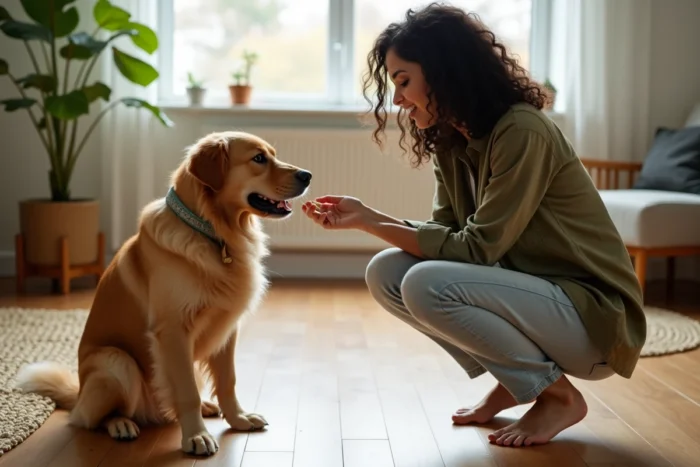
Positive education applied to dogs and cats is based on reinforcing desired behaviors rather than punishment. But what happens when the problem to solve is not a lack of obedience, but rather a degraded emotional state: chronic stress, fear of noises, excessive reactivity? Comparing the effectiveness of this method according to the type of difficulty encountered allows for a better understanding of its real contributions and areas of friction.
Positive education in the face of stress and fear: comparative effectiveness depending on the context
Recent specialized content distinguishes two main categories of situations where positive education is applied: classical learning (recall, leash walking, house training) and emotional disorders (anxiety, reactivity, phobias). The results are not symmetrical.
| Situation | Positive method | Coercive method | Determining factor |
|---|---|---|---|
| Learning basic commands | Quick results, lasting motivation | Immediate obedience, risk of fear | Consistency of the reward signal |
| Anxious or fearful dog | Slow but stable progress | Frequent worsening of stress | Adaptation of the daily environment |
| Reactivity outdoors (other dogs, noises) | Effective gradual desensitization | Temporary inhibition, relapses | Controlled exposure in stages |
| Stigmatized breed dog (category 1 or 2) | Clarity of rules, cooperation | Reinforcement of distrust | Regularity and clear framework of the home |
This table summarizes the trends documented by behavioral educators and ethologists consulted in recent publications. The main finding: the positive method does not work alone in the face of emotional disorders. It largely depends on what happens outside of learning sessions.
On Animaleo, owners find resources that complement this logic by linking education and the overall well-being of the animal.
Home environment and limits of positive reinforcement
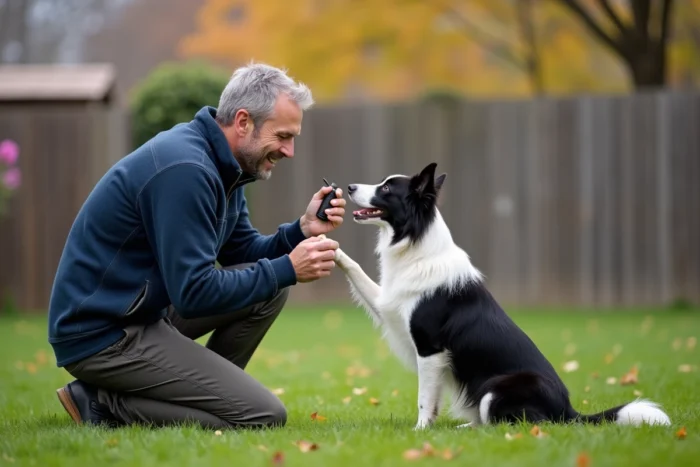
Reinforcing a calm behavior with a treat or a pet loses its effect if the animal then returns to an environment that generates stress. This is the most documented limit of positive education applied to anxious or overstimulated dogs.
What the environment concretely changes
Several specialized sources emphasize three elements of the living environment that condition the success of the method:
- An accessible refuge space at all times, where the animal can isolate itself without being disturbed, reduces cortisol spikes related to domestic overstimulation
- Stable routines (meal times, outings, rest) give the animal predictability about what will happen, decreasing anxious anticipation
- Species and individual-appropriate enrichment of the environment: occupation toys, chewing, olfactory trails for dogs, high observation posts for cats
Without these adjustments, positive reinforcement acts on the symptoms without changing the cause of the discomfort. A dog that receives a reward for lying calmly in the living room, but lives in a noisy home without any retreat space, will only progress temporarily.
Progressive socialization: exposure in stages
Socialization, often associated with positive education, is not just about putting a dog in contact with other animals or strangers. Current recommendations advocate for a step-by-step introduction of new stimuli: noises, places, people, other dogs.
The principle is simple: each new exposure is done at a sufficient distance so that the animal remains below its reactivity threshold. The reward occurs when the dog adopts a calm behavior in the presence of the stimulus. Increasing the intensity too quickly negates the benefits and can create new negative associations.
Positive educational framework for reactive dogs: what works and what blocks
The most telling cases concern highly reactive dogs, including those from often stigmatized breeds. For these animals, coercive education regularly produces the opposite effect of what is sought: inhibition replaces cooperation, and relapse occurs as soon as the pressure decreases.
In contrast, positive education achieves measurable results when it is based on a precise framework. The consistency of the rules matters more than their severity. A reactive dog needs predictability, not fluctuating authority.
This framework assumes that all household members apply the same instructions. Inconsistency between two family members (one allows the couch, the other forbids it) generates confusion, which fuels reactivity. The positive method does not fail due to a lack of firmness, but due to a lack of clarity.
When the method alone is not enough
Some situations exceed the scope of positive education in the strict sense:
- An animal whose stress is related to undiagnosed chronic pain will not respond to behavioral protocols as long as the physical cause is not treated
- A household whose daily organization is incompatible with the needs of the species (prolonged absence, total lack of outings, very limited living space) cannot compensate with reinforcement sessions
- Positive education does not replace a behavioral veterinary assessment when issues have been present for a long time or worsen despite adjustments
This distinction between what falls under learning and what falls under medical care is still little addressed in mainstream content. However, it constitutes the clearest boundary of the method.
Positive education does indeed transform the relationship between an owner and their animal, provided it is not reduced to a reward technique. Its effectiveness depends on the overall home environment, the consistency among family members, and the ability to identify when veterinary support becomes necessary. Positive reinforcement is a lever, not a standalone solution.