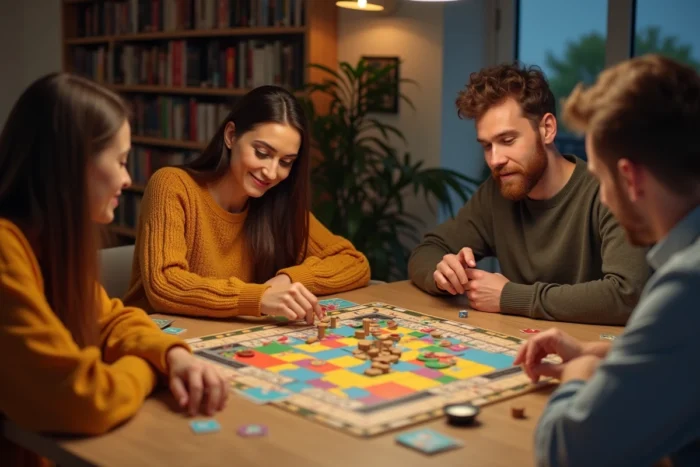
The board game market is undergoing a period of rapid transformation. Publisher catalogs expand every year, mechanics intersect, and formats shorten or lengthen depending on the target audiences. Behind this abundance, underlying trends are reshaping what players buy, how they play, and what they expect from a box placed on the table.
Hybrid Board Games: When the Board Meets the App
Since 2024, a category of games known as phygital is gaining ground. The principle: a physical board accompanied by a companion app that manages the narrative, random events, or campaign tracking. Cooperative and investigative games are the first to be affected.
The app does not replace the material. It handles what a rulebook struggles with: soundscapes, branching scenarios, and managing a virtual opponent. For narrative adventure games, this format eliminates the need for a human game master.
Field feedback diverges on this point. Some players appreciate the fluidity brought by the app, while others feel that the screen breaks the social dynamic around the table. Publishers offering an optional “no app” mode seem to be better received than those that impose the smartphone as a mandatory component.
Among the French-speaking resources closely following these developments, Le Chaudron Des Jeux provides detailed reviews covering both classic games and these hybrid formats.
Family and Mid-Weight Games: The Segment That Is Growing in Stores
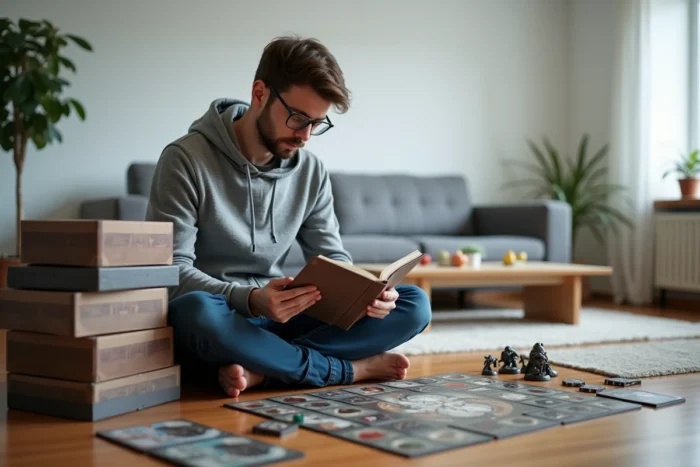
Highly expert games, those lasting over two hours and whose learning curve discourages newcomers, have seen their sales stagnate since the health crisis. In contrast, family and mid-weight games are significantly progressing, especially in general retail.
This phenomenon can be explained by a dual movement. On one hand, the pandemic has attracted a broader audience to board games, seeking accessible sessions without sacrificing depth. On the other hand, publishers have learned to design games with rules that fit on two pages but remain different in each session.
What Mid-Weight Means in Practice
A mid-weight game sits between a quick party game and an expert game. The playtime generally lasts between 45 minutes and an hour and a half. The mechanics often combine two or three systems (trick-taking and hand management, placement and secret objectives, drafting and engine building).
Mid-weight games appeal because they respect the player’s time. There’s no need to block off an entire afternoon. A couple, a group of friends during the week, a family with teenagers: the format suits various configurations without requiring heavy preparation.
Eco-Design of Board Games: Increasing Pressure on Publishers
Specialized content extensively discusses mechanics and releases but rarely addresses a topic that is rising in discussions among players and shops: the environmental impact of board games.
The pressure focuses on several axes:
- Reducing plastic in inserts and components, with a return to cardboard, wood, or compostable materials for internal storage
- Choosing certified cardboard and vegetable inks, which some European publishers are beginning to display on their boxes
- Partially relocating production to Europe, while the majority of manufacturing remains concentrated in Asia
- Transparency in the production chain, demanded by independent shops wanting to inform their customers
The available data does not allow us to conclude that eco-design significantly influences purchasing decisions at this stage. The most engaged players pay attention to it, but the main criterion remains gameplay quality. A poorly designed game in recycled cardboard does not sell better than a good game in plastic.
Tips for Choosing a Board Game Suitable for Your Group
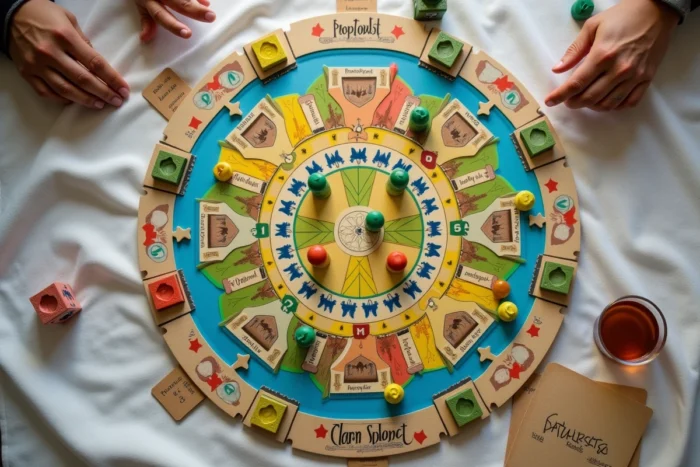
The number of players indicated on the box tells only part of the story. A game marked “2 to 5 players” rarely works equally well in all configurations. Reviews from experienced players often specify the optimal number, which differs from the maximum number.
Three Often-Underestimated Criteria
- The actual duration of the first game almost always exceeds the estimate printed on the box, sometimes by double. Count the time for explaining the rules, especially with casual players
- The level of interaction between players varies greatly from game to game. A duel or trick-taking game creates direct tension, whereas a solo engine-building game may leave some players passive
- The theme matters less than the mechanics for replayability. An ambiance game with an appealing theme but repetitive mechanics becomes tiresome after a few sessions, while a mechanically rich yet simple card game can last for months
The best selection starts from the actual group: how many people, what time is available, what appetite for complexity. A solo player, a couple in a duel, a table of six in the evening: these three situations call for fundamentally different games.
The market today offers enough references to cover every configuration with solid titles. The difficulty is no longer finding a good game, but filtering through a plethora of options to find one that fits a specific situation. Specialized review sites, filmed gameplay videos, and player communities remain the best filters before making a purchase.