
When a death occurs, the family often has less than 48 hours to make binding decisions: type of ceremony, choice of coffin, transportation of the body, administrative formalities. It is within this constrained timeframe that funeral expertise becomes crucial. Understanding what this profession truly entails allows for better anticipation of the necessary steps and helps avoid costly or painful mistakes.
Regulatory framework for the funeral advisor diploma in 2026
The national diploma of funeral advisor (RNCP 36840, level 4) has been revised with new examination modalities applicable to sessions starting from January 1, 2026. It involves a program set at 280 hours: 140 hours of theoretical training and 140 hours of internship in a funeral company. The eight theoretical modules cover funeral legislation, sales advice, hygiene and safety, as well as grief psychology.
This requirement stems from decree n° 2012-608 of April 30, 2012, which reserves the reception and advice of families to holders of this diploma only. A non-qualified professional cannot legally conduct a sales interview with a grieving family.
This strict framework clearly distinguishes the funeral advisor from other roles within a funeral company. A bearer, for example, only needs 16 hours of mandatory training. The difference in hourly volume reflects the complexity of the advisory role: it is not just about handling a coffin; it involves engaging a family in heavy financial and emotional choices.
To delve deeper into training pathways and access routes to the funeral sector, the resources available on fefa.fr detail the various recognized professional paths.
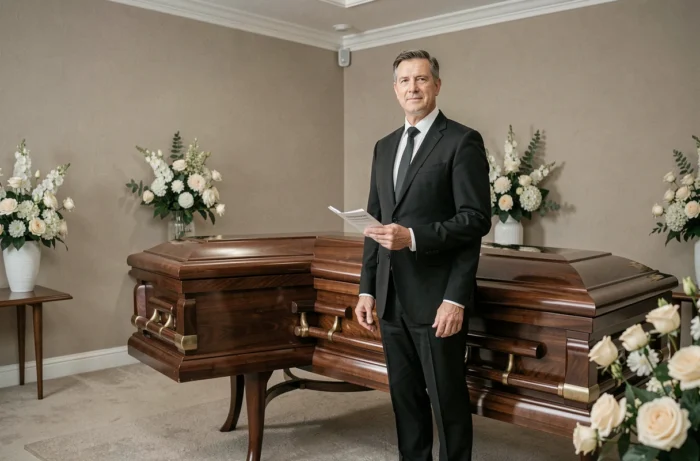
Information obligations of funeral operators: the standardized notice
Recently, funeral operators must provide families with a standardized information notice. This obligation aims to make prices and services comparable from one establishment to another, in a sector where price discrepancies remain significant for sometimes identical services.
In practice, this notice must clearly present the details of mandatory services (provision of the coffin, transportation before and after the body is placed in the coffin, administrative procedures) and optional services (preservation care, lining, plaques, flowers). The funeral advisor is required to provide this document before any signing of a quote.
For families, this notice changes the game. They can compare two quotes line by line instead of relying on an opaque global package. The competent funeral advisor uses this document as a tool for transparency, not as an administrative constraint.
Distinguishing regulated functions within funeral services
The funeral sector is not limited to the advisor. Each function has its own training requirements, and confusing them can create problematic situations during a control or dispute.
- The funeral advisor conducts interviews with families, organizes funerals, and coordinates all service providers (florists, stonemasons, officiants). They must hold the national diploma of 280 hours.
- The master of ceremonies directs the proceedings of the funeral on-site, from the lifting of the body to burial or cremation. Their mandatory training is distinct from that of the advisor.
- The bearer is responsible for handling and transporting the coffin. With only 16 hours of required training, their scope of intervention is strictly limited to physical operations.
- The embalmer performs preservation care for the body. This profession requires a specific diploma, awarded after a lengthy training that includes anatomy and chemistry.
This distribution of roles is not trivial. When a family enters a funeral agency, it is the qualified funeral advisor who must receive them, not a versatile agent without the appropriate qualifications.

Grief support: what the funeral advisor concretely manages
Beyond the logistics of the funeral, the funeral advisor operates in an emotional realm where communication errors can have lasting consequences. Welcoming a family in the hours following a death requires active listening skills that the training now explicitly incorporates into its modules.
Specifically, the advisor must identify the wishes of the deceased (existing funeral contract, orally expressed wishes, religious or philosophical beliefs) while managing family disagreements. Responses vary on this point: some families arrive with clear instructions, while others discover at the meeting that they have never discussed the subject.
The advisor guides without deciding for the family. They present the options, itemize each line of the quote, explain the legal deadlines, and leave the final choice to the relatives. This positioning requires both technical mastery and relational intelligence.
Digital developments in the funeral sector
The funeral sector is not immune to digital transformation. Interactive kiosks are appearing in some cemeteries, allowing visitors to locate a grave or access information about the deceased. Specialized platforms for the transmission of digital heritage are also emerging, raising questions about the management of online accounts after a death.
These tools do not replace the funeral advisor, but they change their scope of intervention. They must now inform families about topics such as closing the deceased’s digital accounts or online memorialization options, issues that did not exist ten years ago.
The profession of funeral advisor relies on a demanding regulatory foundation and relational skills that technology alone cannot replicate. For families, knowing that this professional is trained, qualified, and subject to transparency obligations remains the best guarantee of dignified support at a time when clarity is often lacking.