
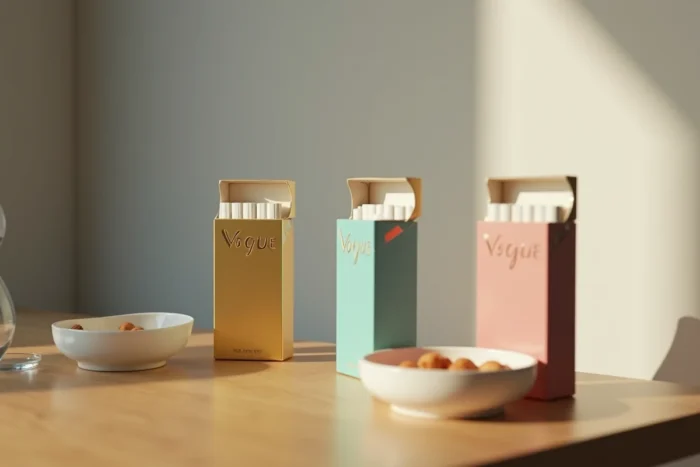
In the French tobacco market, Vogue cigarette packs stand out with a color palette that goes beyond mere visual identity. Each shade corresponds to specific technical choices regarding the filter, format, and composition, with direct consequences on throat sensation, perceived smoothness, and aftertaste. Understanding what this color coding entails allows one to grasp how the tobacco industry shapes the smoking experience without always making it explicit.
Vogue Filter Ventilation: The Mechanism Encoded by the Pack Color
The technical parameter most directly linked to the pack color is the filter ventilation level. Each Vogue variant incorporates a micro-perforation system in the filter, which mixes a variable proportion of ambient air with the inhaled smoke.
Variants associated with lighter shades (blue, white, mint depending on the markets) exhibit high ventilation. The air dilutes the smoke before it reaches the throat, resulting in a smoother hit and a less pronounced aftertaste. Conversely, variants with darker tones reduce this ventilation: the smoke arrives less diluted, the mouthfeel is fuller, and the tobacco flavor is more pronounced.
The difference between the colors of Vogue cigarettes thus largely relies on this ventilation adjustment, rather than a simple variation in tar or nicotine levels as many consumers assume.
This system raises a rarely discussed question: ventilation alters the perception of smoke without necessarily reducing actual exposure to toxic substances. A smoker who draws harder on a highly ventilated cigarette mechanically compensates for the dilution, which can negate the perceived benefit of smoothness. Available data do not allow us to conclude that lighter variants are less harmful than darker ones.

Super Slim Format and Pastel Colors: A Game-Changing Draw
Vogue packs in pastel colors (pink, lilac) most often correspond to super slim formats. The reduced diameter of the cigarette significantly alters the draw: one must inhale harder to achieve a smoke volume comparable to that of a standard cigarette.
The super slim format produces a tighter draw and smoke perceived as drier. This physical characteristic directly influences the perceived taste. The tobacco flavor seems more concentrated on the first puffs, then quickly fades, giving an overall impression of lightness.
This format also affects the combustion duration. A super slim cigarette burns faster than a standard diameter cigarette, which shortens exposure to smoke per unit smoked, but encourages some smokers to chain cigarettes to regain the same satisfaction.
Price Positioning and Brand Image
Pastel super slim variants are often positioned at a slightly different price segment from the rest of the range. The pack conveys an image associated with fashion and refinement, targeting a specific consumer profile.
This marketing positioning does not alter the chemical composition of the product, but it influences the subjective perception of taste. Several field reports indicate that smokers attribute a finer flavor to pastel cigarettes, while the difference primarily lies in the format and draw.
Tar and Nicotine Levels by Vogue Variants
European regulations require the display of tar, nicotine, and carbon monoxide levels on each pack. The different colors in the Vogue range correspond to variable levels, but the differences between variants remain within a narrow range compared to the differences between brands.
- Light variants display the lowest tar levels in the range, contributing to a smoke perceived as less harsh and a more discreet aftertaste.
- Intermediate variants have a moderate nicotine level, with a balance between throat hit and smoothness that many smokers describe as the most satisfying compromise.
- Dark variants concentrate the highest levels, producing a bolder sensation, a more pronounced tobacco flavor, and a lingering aftertaste.
These differences in levels are real, but they only tell part of the story. Filter ventilation and cigarette format play at least as significant a role in the sensation perceived by the smoker.
Perceived Taste and Actual Taste: What Color Doesn’t Reveal
The perception of a cigarette’s taste depends on factors that the color code does not reflect. The state of the smoker’s taste buds, their frequency of consumption, and their level of nicotine dependence significantly alter the sensory experience.
Tobacco alters the taste capabilities of regular smokers. Physiological studies have shown that cigarette smoke causes dysgeusia (altered taste) related to chronic inflammation of the taste buds and reduced saliva flow. A daily smoker thus perceives the nuances between Vogue variants less distinctly than an occasional smoker.
Field reports vary on this point: some consumers claim to perceive a marked difference between colors, while others, after years of smoking, can hardly distinguish between light and dark variants. The pack color creates a psychological expectation that guides perception, a mechanism well documented in sensory marketing.
The Role of Additives and Tobacco Treatments
Beyond the filter and format, the treatment of the tobacco itself varies by variant. Some Vogue references use treated tobacco to reduce bitterness, while others incorporate texture agents that modify combustion. These treatments influence the aftertaste as much as the displayed tar level.
European regulations have banned characterizing flavors (menthol, vanilla, fruits) in cigarettes for several years. The taste differences between Vogue colors now rely on more subtle parameters: tobacco quality, ventilation, format, and non-aromatic additives.
Vogue Pack Color and Smoker Choice: Beyond Marketing
The color coding system serves as a guiding function for consumers in the tobacco market. After the ban on “light” or “mild” labels on packs, color has become the main visual marker allowing smokers to identify their variant.
- Smokers seeking smoothness gravitate towards lighter or pastel shades, associated with high ventilation and a slim format.
- Those who prefer a pronounced taste opt for dark variants, with less ventilation and a more direct hit.
- Occasional smokers often choose intermediate colors, perceived as a compromise between flavor and comfort.
Color guides choice but does not guarantee the sensory experience. The same pack smoked by two people with different habits will produce distinct sensations. The Vogue color code remains a useful indicator as long as one understands the technical mechanisms it encompasses, rather than sticking to the implicit promise of the packaging.