
Optimizing recovery after a workout relies on hierarchical physiological levers. We structure these ten tips according to the 5R model (Replenish, Repair, Reinforce, Rehydrate, Rest), which links each action to a specific metabolic goal rather than an arbitrary list.
1. Adjust the carbohydrate-protein ratio based on the type of session

The generic advice “eat carbohydrates and proteins” masks a crucial nuance. Recent recommendations advocate for a ratio of about 3:1 carbohydrates to proteins after an endurance session, compared to a ratio closer to 2:1 after a strength training session.
In endurance, the priority is to replenish muscle glycogen, hence the dominant carbohydrate component. In strength training, protein synthesis takes precedence, which justifies a proportionally higher protein intake. Ignoring this distinction amounts to underfeeding the repair process targeted by the session.
We recommend consuming this meal or snack within the first thirty minutes following exertion, when the muscle absorption window remains optimal. There are also many tips for recovery after sports that detail these nutritional strategies based on training profiles.
2. Prioritize sleep and stress management over any recovery tool

Sleep is not just one pillar among others. It is the non-negotiable foundation without which massage guns, cold baths, and compression lose most of their effect. Recent content establishes a clear hierarchy in four levels of priority: sleep and stress management at the top, sufficient nutrition second, active recovery third, and technological tools fourth.
A sleep deficit negates a large part of the muscle adaptations achieved during the session. Before investing in equipment, we advise stabilizing the duration and regularity of sleep, maintaining consistent bedtimes even on non-training days.
3. Rehydrate with alkaline water for prolonged efforts

Classic rehydration with still water is sufficient for short sessions. For very prolonged efforts, the French Cardiology Federation recommends sipping up to 1.5 liters of alkaline water in the hours following training. The goal is to compensate for losses in chloride, sodium, and potassium while reducing acidity related to lactic acid accumulation in muscle fibers.
Do not wait for thirst to drink. Thirst is already an advanced sign of dehydration, meaning that the fluid deficit is already affecting cellular recovery capabilities.
4. Practice an active cool-down rather than a sudden stop

Active recovery, in the form of light jogging or low-intensity cycling for ten to fifteen minutes, accelerates the elimination of metabolites accumulated during exertion. This mechanism relies on maintaining sufficient blood flow to drain lactic acid from the engaged muscles.
We observe that practitioners who go directly from intense effort to complete stillness experience more stiffness the next day. The active cool-down acts as a physiological transition between the catabolic phase of training and the anabolic phase of recovery.
5. Stretch moderately and never cold on fatigued muscles

Intense static stretching immediately after exertion exacerbates muscle microtears. We recommend gentle stretches, held for a maximum of ten seconds, without forcing the range of motion. The goal is not to gain flexibility at that moment, but to release residual tension.
For heavy strength training sessions, postponing stretching to the next day or the day after is often preferable. The fibers damaged by concentric effort do not need additional mechanical strain in the hour following.
6. Use graduated compression during the post-effort phase
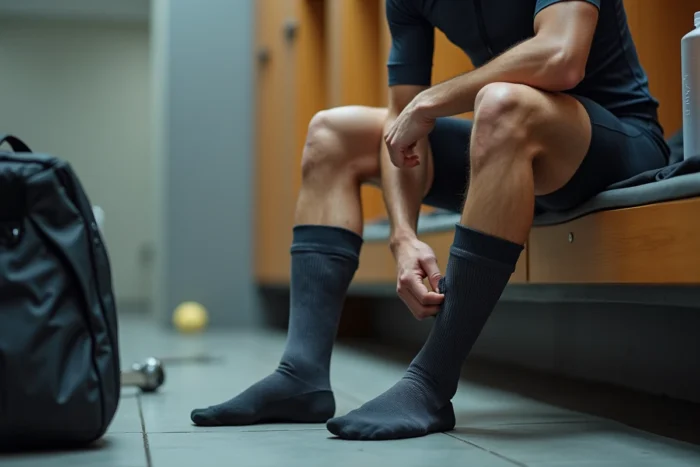
Graduated compression garments exert decreasing pressure from the bottom to the top of the limb, promoting venous return. This mechanism reduces the accumulation of interstitial fluid and can alleviate the sensation of heavy legs after endurance efforts.
Compression ranks third or fourth in priority within the recovery hierarchy. It does not replace sleep or nutrition, but usefully complements these pillars for regular practitioners who engage in multiple sessions per week.
7. Apply cold in a targeted manner and not systematically

Cold water immersion reduces local inflammation and the perception of pain. Its systematic use after every strength training session remains debated: the post-effort inflammatory response contributes to muscle adaptation, and suppressing it every time could hinder long-term strength gains.
We reserve cold for situations of overload (competition, double sessions, blocks of intensive training) where the priority is to limit damage rather than maximize adaptation. A ten to fifteen-minute immersion in cool water is sufficient.
8. Integrate foam rolling on the engaged muscle groups

Foam rolling applied to the worked muscle groups improves local perfusion and reduces the perception of stiffness. Unlike passive massage performed by a practitioner, self-massage allows for real-time pressure adjustment based on the sensitivity of each area.
Some points to follow:
- Roll slowly over each group for one to two minutes, avoiding pressure on joint areas
- Avoid rolling directly over an inflamed or bruised area
- Focus on large muscle groups (quadriceps, hamstrings, calves, lats) rather than small stabilizers
9. Work on joint mobility the day after the session

Joint mobility should not be confused with stretching. It involves controlled movements through the full range of the joint, performed dynamically. This practice reduces residual stiffness without imposing passive strain on tissues still in the repair phase.
We recommend placing these mobility routines the day after the session, ideally in the morning. Five to ten minutes targeting the hips, shoulders, and thoracic spine is sufficient for most practitioners.
10. Plan complete rest days according to training load

Complete rest is not an admission of weakness but a legitimate training parameter. Continuing sessions without off days leads to overtraining, which manifests as decreased performance, sleep disturbances, and increased susceptibility to injuries.
The frequency of rest days depends on the overall volume and intensity. Practitioners training four to five times a week need at least two complete rest days, not necessarily consecutive. Monitoring heart rate variability upon waking provides a reliable indication of the autonomic nervous system’s recovery status.
Recovery after sports is managed like training itself: with a logic of priorities. Sleep, nutrition tailored to the type of session, and hydration form the foundation. The tools (compression, cold, self-massage) only add value if this foundation is solid.